3K vs 12K Carbon Padel Rackets: What the Number Really Means
You will see 3K, 12K and 18K on almost every carbon padel racket. The number is real, but it is often sold as a simple quality ranking. It is not. Here is what it actually tells you, what it does not, and how to use it when you are choosing a racket. We make 12K carbon rackets, so read this knowing that.
What the K number measures
Carbon fibre is made of very thin filaments grouped into bundles called tows. The K number is the number of filaments in each tow, in thousands.
- 1K = 1,000 filaments per tow
- 3K = 3,000
- 12K = 12,000
- 18K = 18,000
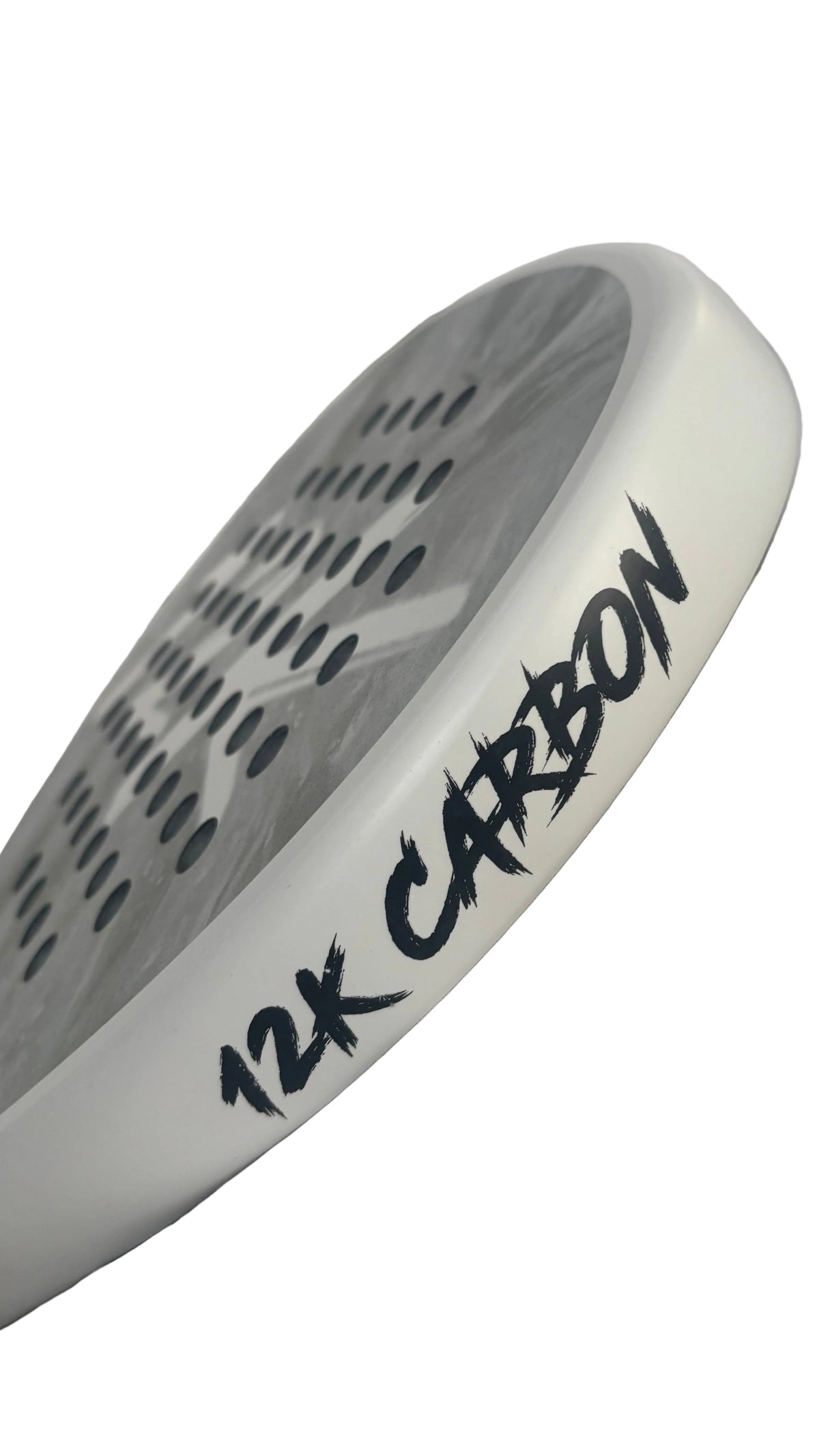
A bigger tow makes a wider, flatter weave pattern. You can see the difference: 3K has the small checkerboard look, 12K a broader one.
3K vs 12K side by side
| 3K carbon | 12K carbon | |
|---|---|---|
| Weave look | Tight checkerboard, squares about 3 mm | Wide bands, squares about 8 to 10 mm |
| Cost per kilo | Higher, more weaving time | Lower, fewer passes on the loom |
| Typical use | Control and beginner rackets, some premium rackets | Power and intermediate rackets, budget rackets, premium rackets |
| Feel on the same build | Marginally more even across the face | Marginally more direct in the centre |
| Durability | Same, decided by resin and edges | Same, decided by resin and edges |
| Spin | Decided by surface texture, not weave | Decided by surface texture, not weave |
Read that table twice. Most of the rows say the same thing on both sides. That is the point.
What it does not tell you
The K number is about how the fibre is bundled, not how much carbon is in the racket or how stiff it is. The feel of a padel racket depends at least as much on:
- how many layers of carbon are used, and at what angles
- the resin and how it is cured
- whether the frame is carbon, glass fibre or a mix
- the core foam, which is the biggest single factor in how soft or firm a racket feels
- the surface texture, which affects spin more than the weave does
So a 3K racket with a firm core can feel stiffer than a 12K racket with a soft one. The K number is one clue, not a verdict.
Four myths worth dropping
"12K is stronger than 3K." Per filament they are the same fibre. Strength comes from layers and resin. A single layer of 12K is not stronger than three layers of 3K.
"12K gives more spin." Spin comes from the surface. A rough finish on any weave grips the ball. A smooth 12K face grips less than a rough 3K face.
"12K is only for pros." Plenty of £60 rackets use 12K because the material is cheaper. Plenty of £250 rackets use 3K. The number does not track level.
"Higher K means a harder racket." Brands often pair 12K and 18K with firm cores, so the association exists. It comes from the core, not the weave.
So why do brands use higher K numbers?
Larger tows are generally cheaper per kilo to produce. Brands often pair 12K or 18K faces with firmer builds aimed at stronger players, which is why the higher numbers have become associated with "more power". That link comes from the whole racket design, not the tow size alone. The other reason is simpler: 12K looks good. The wide weave under a clear coat is what people picture when they think of a carbon racket, and it sells.
A five minute test you can do in a shop
If you have two rackets in front of you and want to know which will suit you, ignore the label and do this:
- Press the centre of each face with your thumb. More give means a softer core. Softer is easier on the arm and more forgiving. Firmer is more direct and more powerful.
- Balance each racket on one finger under the throat. If the head drops, it is head heavy: more power on smashes, more load on the elbow. If it sits level or the handle drops, it is easier to swing at the net.
- Look at the shape. Round for control, diamond for power, teardrop for the middle ground. This matters more than anything printed on the frame.
- Run your palm over the face. Rough texture helps spin. Smooth is fine for flat hitters.
- Only then read the carbon grade. By now you already know which racket you prefer.
Which should you choose?
Choose on shape, weight, balance and core first. Then look at the carbon.
- New to padel, or your arm is sore: a round shape and a soft core matter more than the K number. Our beginner racket guide covers this.
- Playing weekly and want more punch: a teardrop with a medium or firmer core. Many of these use 12K or 18K faces, including ours. See the intermediate racket guide.
- Advanced, attacking: diamond shapes and hard cores, where 12K and 18K faces are common.
Durability and price
Carbon faces crack at the edges, not in the middle, and they crack because of wall contact and floor knocks rather than because of tow size. A head protector does more for the life of a 3K or 12K racket than any difference between the two weaves.
On price, 12K sits at both ends of the market. It is on £60 rackets because the raw material is cheaper, and on £250 rackets because it looks premium. What you pay for above about £100 is mostly the brand, the distribution chain and the sponsored players. We sell direct at £79.95, so the price is the carbon and the courier.
About our rackets
All three 12k Padel rackets use a 12K carbon fibre face with a medium EVA core, a teardrop shape and a 365 g weight. They are aimed at improving and intermediate players. If you are brand new and want maximum comfort, a softer round racket may suit you better to start. See the rackets.
Frequently asked questions
Is 3K or 12K better for beginners?
Neither. Beginners should choose a round shape and a soft or medium core. The weave is irrelevant at that stage.
Can you feel the difference between 3K and 12K?
On an identical build, most players cannot in a blind test. What you feel is the core, the layers and the balance.
What about 6K carbon?
6K sits between the two and is less common in padel. Same rules apply. See carbon grades 3K to 18K.
Is 12K carbon the same as full carbon?
No. Full carbon means the frame and both faces are carbon rather than fibreglass. 12K only describes the weave of the face. A racket can be 12K face with a fibreglass frame.
Related reading: What is 12K carbon? · Best carbon padel rackets under £100 · EVA vs soft cores · Carbon vs fibreglass