Best Padel Racket for Beginners in 2026: What Actually Matters
Every beginner guide tells you to "get a racket that suits your level." That is not useful advice. What actually matters is understanding the four things that change how a padel racket feels in your hand: shape, weight, carbon, and balance. Once you know those, the right choice becomes much clearer. We make padel rackets, so we have been careful to say where ours is not the right answer.
Shape: round, teardrop, or diamond
Round rackets have the largest sweet spot. The hitting zone sits closer to your wrist, which gives you more control and more margin for off centre hits. For a beginner, that forgiveness is everything. Teardrop shapes move the sweet spot slightly higher and add a touch more power while keeping decent control. Diamond shapes push the weight to the head for maximum power, but they punish mistimed shots. Start with round or teardrop. You can always move to diamond later once your timing is consistent. More in our shapes guide.
Weight: why 350g to 370g is the range
Heavier rackets generate more power but tire your arm faster. Lighter rackets are easier to swing but can feel hollow on hard shots. Most adult beginners do well between 350g and 370g. If you have played other racket sports before, you can go toward the higher end. If padel is your first racket sport, or your elbow complains, start lighter.
Carbon: what the numbers mean
Carbon fibre is described by how many filaments are bundled in each strand: 3K is 3,000, 12K is 12,000. The number tells you about the weave, not the whole racket. How firm a racket feels depends just as much on the core foam and the number of layers. For a complete beginner, a soft core matters more than the K number. For an improving player, a firmer carbon face gives clearer feedback on good and bad contact. More in 3K vs 12K explained.
Balance: head heavy vs head light
Balance describes where the weight sits along the racket. Head heavy rackets put more mass toward the top, which adds power on smashes and bandeja shots. Head light rackets keep the weight closer to the grip, making them quicker to manoeuvre at the net. For beginners, even or slightly head light balance is the safest choice.
Price: what you actually need to spend
You do not need to spend £250 on your first racket. Very cheap rackets can be inconsistent, but above about £150 much of the extra cost is brand, sponsorship and retail margin rather than anything a beginner will feel. For most beginners, £60 to £100 buys a well-made racket. We compared seven carbon options in that range, including ours, in best carbon padel rackets under £100.
Which beginner are you?
- Brand new, never played a racket sport: a round racket with a soft core, around 350 g. Ours is not the best fit for you yet.
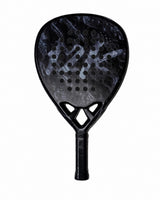
- A few sessions in, or you played tennis or squash: a teardrop around 355 to 365 g with a medium core will last you longer. That is where the 12k Padel Midnight Black, Shark Blue and Ice White sit: 12K carbon face, teardrop, 365 g, medium EVA core, £79.95.
- Sore elbow or wrist: go lighter, rounder and softer, whatever the brand.
Whatever you buy, fit an overgrip and a head protector from day one.