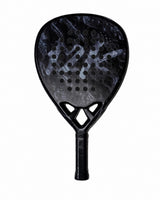
Best Padel Racket for Intermediate Players: What to Look For
You have been playing for six months, maybe a year. You can hold a rally, you know where to stand, and the beginner racket that felt fine in week one now feels a bit vague. Every shot needs more effort than it should. That feeling is the whole reason the phrase best padel racket for intermediate players gets searched so much in the UK, and the answer is less about a brand name and more about four specs.
Get those four right and the racket stops holding you back. Get them wrong and you either buy a beginner racket in a new colour or a pro racket you cannot control.
Are you actually intermediate?
Be honest here, because the wrong answer costs money. You are intermediate if you can serve consistently, return most balls off the back glass, volley without panicking and win points on purpose rather than by accident. Roughly a 2.5 to 4.0 rating if your club uses the UK scale.
If you still shank one ball in five, you are a strong beginner, and the forgiving round racket is still your friend. If you are winning club tournaments and smashing for winners at will, you are past this article and probably know what you want already.
Shape: teardrop, almost every time
A round racket keeps the sweet spot dead centre and gives you maximum forgiveness. A diamond pushes it to the top of the face for power at the cost of a smaller hitting zone. Teardrop sits in between, and that middle ground is exactly where an improving player lives.
The sweet spot on a teardrop is nudged slightly higher than on a round frame. You get more depth on lobs and more bite on overheads without losing the racket on off-centre hits. It grows with you, which matters because you will keep improving for the next two years. Our guide to padel racket shapes goes deeper if you want the full picture.
Weight: 355 to 370 grams
Most beginner rackets sit around 340 to 355 grams so they are easy to swing. Intermediate players usually benefit from a little more mass, somewhere in the 355 to 370 gram range. The extra weight adds stability on volleys and stops the racket twisting when you block a hard ball.
Go too heavy and your arm fades in the third set. Stay too light and every fast exchange at the net feels like the racket is being pushed around. Around 365 grams is the number most club players settle on once they try a few, and it is the weight every 12k Padel racket is built to. If weight is the part you are unsure about, read our padel racket weight guide before deciding.
Balance: medium
Balance describes where the weight sits along the frame. Head heavy rackets feel powerful but slow. Head light rackets feel quick but need you to generate all the pace yourself. Medium balance, sometimes labelled medium high on a teardrop, gives you enough mass up top to hurt people on the smash while keeping the racket manoeuvrable for reflex volleys.
This is the spec beginners are told to ignore and intermediates are told to obsess over. Neither is right. Just avoid the extremes at this stage and you will be fine.
Core and face: medium EVA, real carbon
The core is the foam inside the frame. Soft cores feel plush and add power on slow swings. Hard cores feel firm and reward fast swings with precise control. A medium density EVA core is the intermediate sweet spot, giving a predictable response without punishing you on the days your timing is off.
The face is where your money goes. Fibreglass is cheaper and softer, and it is what most beginner rackets use. Carbon fibre is stiffer, more durable and gives a crisper feel when you strike clean. Once you are hitting the middle of the face regularly, carbon rewards that consistency in a way fibreglass cannot. A 12K carbon weave is the higher grade you will see on serious rackets, and it holds its shape over hundreds of sessions rather than going soft after a few months.
How much should you spend?
You do not need to spend two hundred pounds. The jump from a fibreglass beginner racket to a genuine carbon teardrop at 365 grams is the one that changes how you play. Beyond that, extra money mostly buys marketing, a name on the throat and cosmetic finishes.
In the UK, a real carbon intermediate racket should cost somewhere between seventy and a hundred and fifty pounds. Above that, you are paying for pro tour branding, which does nothing for your backhand.
Common questions from players upgrading
When is the right time to upgrade?
Most players are ready between six and twelve months in, sooner if you have weekly coaching. The tell is feel. Your beginner racket starts to seem mushy or slow, and you find yourself wanting more depth on lobs and more punch on volleys. That is your technique outgrowing your kit.
Can an intermediate use a diamond racket?
You can, but most should not yet. A diamond asks for clean contact on every shot and a shoulder that can swing a head heavy frame for ninety minutes. If your smashes are still inconsistent, a diamond will make them worse, not better. Teardrop gives you eighty percent of the power with far more margin for error.
Should I get a rough or smooth face?
Rough faces grip the ball for a fraction longer and help with spin on slices and viboras. Smooth faces give a cleaner, more direct strike. At intermediate level it is a preference rather than a rule, though most improving players find a lightly textured face helps them add spin without changing their swing.
The short version
Teardrop shape. Around 365 grams. Medium balance. Medium EVA core. Carbon face. That is the spec sheet for an intermediate racket, and anything that ticks all five will serve you well for the next two or three years of improvement.
At 12k Padel we built the whole range to exactly that spec because it is what most UK club players actually need. If you want a 12K carbon teardrop at 365 grams without the pro tour price tag, the Shark Blue is the one to try.