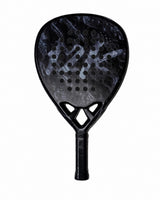
Best Padel Racket for Tennis Elbow: What Specs Actually Help

Tennis elbow is the injury that quietly ends padel for a lot of UK club players. It starts as a dull ache on the outside of the elbow after a long session, then it stays for weeks. If you search for the best padel racket for tennis elbow, you will find plenty of model names and very little explanation of why one racket hurts and another does not.
The racket is not the cure. Rest, a physio and better technique do most of the work. But the wrong racket loads your forearm on every single strike, and the right one takes a surprising amount of that load away. This guide covers the four specs that matter and the ones that are mostly noise.
Why a padel racket causes elbow pain in the first place
Every impact sends a shock wave up the frame, through the handle and into the tendons that attach at your elbow. Hit the middle of the face and most of that energy goes into the ball. Hit near the edge and the frame twists, the shock spikes and your forearm muscles fire hard to stop the racket rotating in your hand.
Do that a few hundred times a week and the tendon gets irritated. So an arm-friendly racket does two jobs. It reduces the vibration on clean hits, and it makes off-centre hits happen less often and hurt less when they do.
Spec one: a core that gives, not a core that fights back
The foam inside the frame decides how much of the impact you feel. Hard cores are firm and precise, and they pass a lot of vibration straight through to the hand. Softer EVA and foam cores compress more on contact, which lengthens the impact time and drops the peak load on your tendon.
If your elbow is sore, avoid anything described as hard or firm. A medium EVA core is the safe middle ground for most club players, because it absorbs the shock without going so soft that the racket feels dead on volleys. Our guide to padel racket cores goes through the differences in detail.
Spec two: weight between 355 and 370 grams
Lighter is not automatically kinder. A very light racket around 340 grams swings fast, but it also transmits more vibration and it twists more easily on off-centre hits, which is exactly the movement your forearm has to fight. A very heavy racket above 375 grams asks more of your shoulder and wrist over a long match.
The band that works for most players with elbow trouble is 355 to 370 grams. It has enough mass to stay stable at contact without being tiring to swing.
Spec three: a big, forgiving sweet spot
Round rackets keep the sweet spot dead centre and large, which is why they are the usual advice for arm pain. Teardrop rackets sit close behind, with a sweet spot that is still generous but sits slightly higher on the face so you keep some power on lobs and overheads. Diamond rackets push the sweet spot to the top and shrink it, and they are the ones to avoid until your elbow is fully settled.
For a club player who is rehabbing an elbow but still wants to attack the net, a teardrop with a medium core is the practical choice. It forgives the mishits that cause the pain and it does not force you to relearn your swing on a frame with no punch.
Spec four: balance away from the head
A head-heavy racket feels powerful, but all that mass at the tip means more strain on your elbow every time you swing and every time you stop the racket. A medium or low balance keeps the weight closer to your hand, so the racket is easier to control and the tendon does less bracing work.
You do not need an extreme handle-heavy frame. Medium balance on a 365 gram racket is enough for most people. Check the balance point rather than trusting the marketing description, because plenty of rackets sold as all-round are noticeably head-heavy in the hand.
The cheap fixes that matter as much as the racket
A worn overgrip makes you squeeze harder to stop the handle slipping, and gripping tight is one of the biggest drivers of tennis elbow. Change the overgrip as soon as it goes shiny, and consider building the grip up slightly if your fingers wrap right round and touch your palm.
Old balls are the other one. A dead ball is heavier and stiffer at contact, and it sends more shock up the frame than a fresh pressurised ball. Playing with a tin that has been open for three weeks is a false economy if your elbow is already talking to you. Our padel elbow prevention guide covers the warm-up and technique side.
Questions players with elbow pain ask
Can you play padel with tennis elbow?
Not during a flare-up. If the outside of your elbow hurts when you grip a mug or shake hands, you need two to four weeks off court and a physio, not a new racket. Once the pain has settled to an occasional ache, you can come back with the right kit, shorter sessions and a proper warm-up.
Is a lighter padel racket better for tennis elbow?
Only up to a point. Going from a heavy 380 gram frame to something around 360 helps a lot. Going from 360 down to 340 usually makes things worse, because the light frame vibrates more and twists more on every mishit. Mid weight, soft to medium core and a forgiving shape beats ultra-light every time.
Does carbon fibre make elbow pain worse?
No, as long as the core underneath it is not hard. Carbon is stiffer than fibreglass, but the face is only one layer of the sandwich. A 12K carbon face over a medium EVA core gives you a crisp, durable strike with the shock still absorbed inside the frame. It is the pairing 12k Padel builds every racket around, and it holds up over hundreds of sessions rather than going soft after a season.
The short version
Soft to medium core. Around 360 to 365 grams. Round or teardrop shape with a big sweet spot. Medium or low balance. Fresh overgrip, fresh balls. That is the whole checklist, and any racket that ticks all of it will treat your elbow a lot better than the one that started the problem.
At 12k Padel we built the range at 365 grams with a medium EVA core and a teardrop sweet spot, which is the arm-friendly middle ground most UK club players are looking for. If you want that spec in a clean carbon frame, the Ice White is the one to try.