Padel Racket Carbon Grades Explained: 3K vs 6K vs 12K vs 18K
If you have looked at padel rackets online, you have seen numbers like 3K, 6K, 12K, and 18K on product listings. These refer to the carbon fibre used in the racket face. The number tells you how many individual filaments are bundled into each strand of carbon. It is useful to know, and it is one part of how a racket feels. We make 12K carbon rackets, so read this knowing that.
What the K number actually means
Carbon fibre is made from thousands of tiny filaments, each thinner than a human hair, grouped into a strand called a tow. The K number is the filament count per tow. So 3K carbon has 3,000 filaments per tow, 6K has 6,000, 12K has 12,000, and 18K has 18,000. Bigger tows make a broader weave pattern on the face, which is why you can often tell the grades apart by eye.
3K vs 6K vs 12K vs 18K at a glance
| Grade | Filaments per tow | Weave | Usually found on | Typical player |
|---|---|---|---|---|
| 3K | 3,000 | Fine checkerboard | Every price level, often comfort-focused builds | Beginner to intermediate |
| 6K | 6,000 | Slightly broader | A middle option in some ranges | Improving players |
| 12K | 12,000 | Broad, clearly visible | Mid-range and premium rackets, medium or firm cores | Improving to advanced |
| 18K | 18,000 | Broadest | Firm, attack-focused rackets | Advanced |
These are typical patterns in how brands build rackets around each grade. The sections below explain what sits behind them.
What else decides the feel
Two rackets with the same K number can feel completely different. The core foam (soft, medium or hard EVA) has the biggest effect on softness and comfort. The number of carbon layers and their angles, the resin, the frame material and the surface texture all matter too. Read the K number together with the core, shape, weight and balance and you have the full picture.
3K carbon
The classic fine checkerboard weave. You will find it across every price level. Brands often pair it with softer builds aimed at comfort and touch.
6K carbon
Less common in padel. Usually a middle option in a brand's range, sitting between the fine 3K weave and the broader 12K.
12K carbon
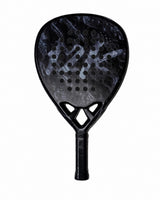
A broader weave, common on mid-range and premium rackets from the big brands, where it is often paired with medium or firm cores for a crisp, direct feel. Our rackets use a 12K carbon face with a medium EVA core, a teardrop head and a 365 g frame.
The 12K carbon racket in this guide
A 12K carbon face, built the way this guide recommends.
12K carbon face, medium EVA core, teardrop head, 365 g. The all-round pairing described above, sold direct at £79.95 with a 12-month frame warranty. Same frame in three finishes.
 Midnight Black
Matte black on black. Quiet until you hit it.
£79.95 · View racket →
Midnight Black
Matte black on black. Quiet until you hit it.
£79.95 · View racket →
 Shark Blue
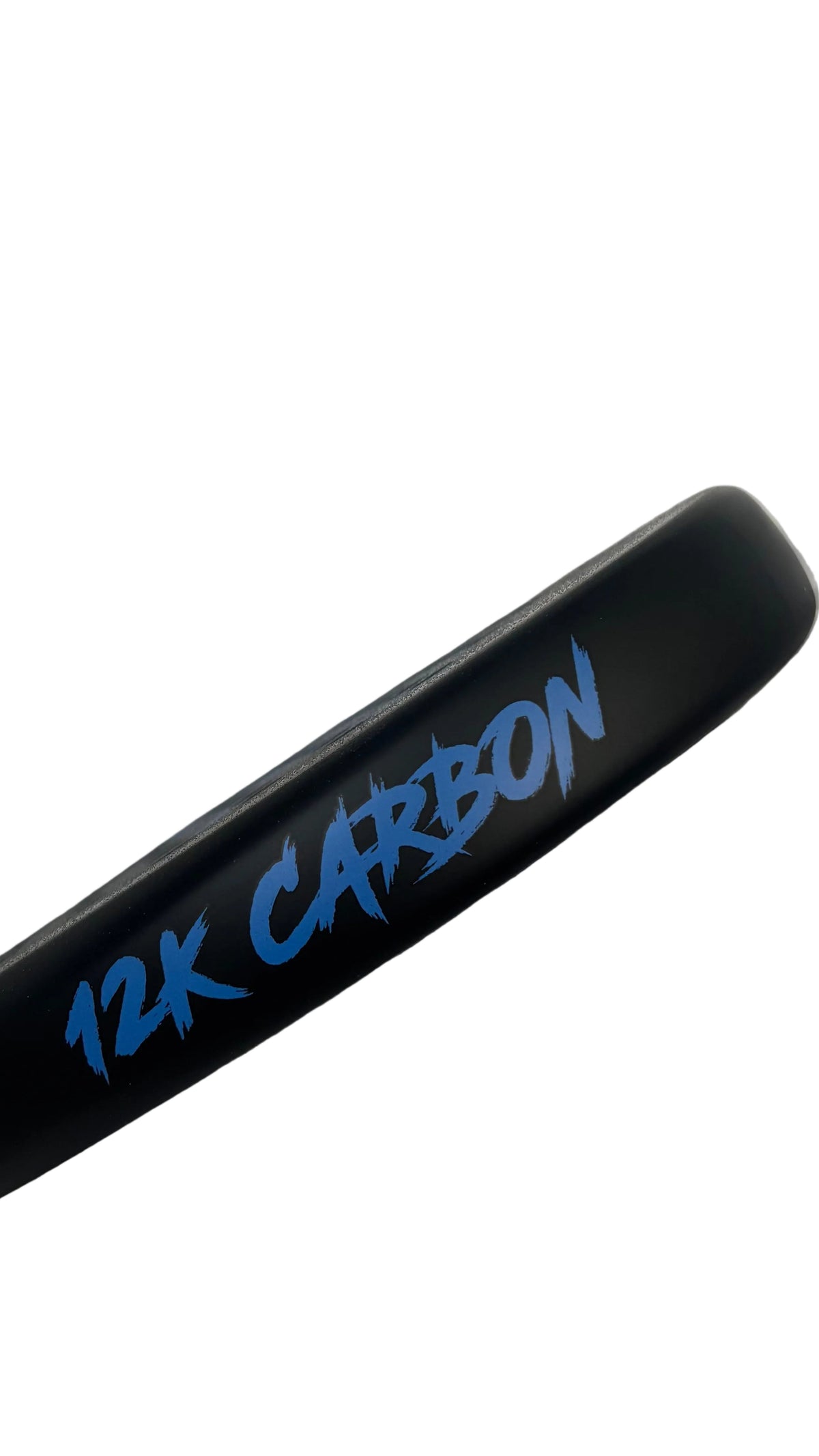
Blue 12K script over black carbon. The one that turns heads.
£79.95 · View racket →
Shark Blue
Blue 12K script over black carbon. The one that turns heads.
£79.95 · View racket →
 Ice White
Clean white face, black frame. Shows every mark you earn.
£79.95 · View racket →
Ice White
Clean white face, black frame. Shows every mark you earn.
£79.95 · View racket →
Need grips and a head protector with it? The Court Pack adds three overgrips, a head protector and a free score keeper for £92.95, delivered free in the UK.
18K carbon
Broader still, and usually found on firm, attack-focused rackets for advanced players. Those builds tend to be less forgiving and pass more vibration to the arm, mainly because of the firm cores and head-heavy balance they are paired with.
12K vs 18K: what is the difference?
The difference between a 12K and an 18K padel racket starts with the tow: 12,000 filaments against 18,000. On court, the bigger difference comes from how each is built. 18K faces usually sit on firm cores with a head-heavy balance, made for players who finish points with power and have the technique to control it. 12K faces are most often paired with medium cores and teardrop shapes, which gives a direct feel with a larger margin for error.
Choose 12K if you want one racket that handles defence, volleys and overheads. Choose 18K if you are an advanced attacking player who wants a firm, demanding racket.
3K vs 12K: what is the difference?
3K has the fine checkerboard weave and is often used on softer, comfort-led rackets. 12K has a broader weave and is often used on rackets with a crisper response. Players moving up from a first racket commonly go from 3K to 12K as their swing gets faster and they want more feedback from the face. We cover this pairing in full in 3K vs 12K carbon padel rackets.
3K vs 6K: what is the difference?
6K doubles the filament count per tow, which gives a slightly broader weave. In practice the two are close, and the core and shape of the racket will tell you more about how it plays than the step from 3K to 6K.
Which grade should you choose?
Choose on shape, weight, balance and core first, then look at the carbon. New players and anyone with a sore arm should look for a round shape and a soft core, whatever the K number. Improving players who want one all-round racket do well with a teardrop and a medium core, which is where many 12K rackets sit, including ours at £79.95. UK delivery is free on orders over £85, so the Court Pack at £92.95 ships free.
Frequently asked questions
Is 12K or 18K better for a padel racket?
12K suits more players. It is usually built into all-round rackets with medium cores. 18K is usually built into firm, power-focused rackets for advanced players.
Is a higher K number always better?
No. The K number is a filament count, not a quality score. The right grade is the one built into a racket that matches your level and style.
What does 12K carbon mean?
Each strand of carbon in the weave contains 12,000 filaments. Read more in what is 12K carbon?
Can beginners use a 12K carbon racket?
Yes, when it is paired with a forgiving shape and a medium core. That combination gives a large sweet spot and room to grow into the racket.
Can you see the difference between carbon grades?
Yes. 3K shows a fine checkerboard, and the squares get larger through 6K, 12K and 18K.
Related: 3K vs 12K explained · carbon vs fibreglass · racket weight explained · carbon rackets under £100