How to Hit a Bajada in Padel: Turn Defence Into Attack
The ball hits the back glass, pops up, and sits there for what feels like a second and a half. Most players scoop it back down the middle and hope for the best.
That is the moment the bajada exists for.
What the Bajada Is
Bajada is Spanish for descent, and that is the shape of the shot. The ball rebounds off the back wall, rises to somewhere between waist and shoulder height, and you hit down through it rather than lifting it.
It is the opposite of what most beginners do from the back. The default reaction to a glass rebound is a lob, which is fine, but it hands the net straight back to the other pair. A bajada keeps you in the point on your terms and sometimes ends it.
The shot is usually flat or lightly sliced. Not a smash, not a full drive. Think of it as a controlled downward push with real intent behind it.
If the back glass still feels like a threat rather than a tool, start with our beginner's guide to using the walls in padel. The bajada is what you build on top of that.
Reading the Rebound First
Not every ball off the glass is a bajada. You need three things: height, time, and a clean bounce.
Height means the ball comes off the wall above waist level. Below that and you are hitting up, which is a different shot entirely. Time means you can get your feet set before contact. A ball spinning off at a strange angle or dying near the corner is a ball you lob.
Deep lobs that clip the glass high and drop steeply are the best candidates. So are lazy defensive lobs that land short of the back wall and sit up. If you are unsure, lob. A bad bajada gives away a free point at the net.
Footwork Is the Whole Shot
Here is what separates a bajada that hurts from one that just gets the ball back. You have to be behind the ball at contact.
Most players stand where they are and let the rebound come to them, which means contact ends up level with or behind their body. From there you cannot generate anything. The arm does all the work and the ball floats.
Move back and across as the ball travels toward the glass. Give yourself more room than feels necessary. When the rebound comes forward, you step into it with your weight moving toward the net and the contact point ahead of your front foot.
Coaches tend to put the ideal starting spot about one big step off the glass. Closer than that and the racket has nowhere to go. Further than that and you are chasing the ball forward instead of stepping into it.
The Timing Habit to Build
Turn side on early. As soon as you see the ball is going to the glass rather than to you, get your shoulders round and your racket up. Players who wait until the rebound to start moving are always late.
Watch the ball onto the wall, not just off it. The angle it hits the glass tells you where it is coming out before it gets there.
Then wait for the ball to start dropping. The most common timing error is attacking while the rebound is still rising, which sends the ball long. The second most common is waiting so long it falls below the waist. The window is the top of the bounce and the first part of the descent.
Grip, Swing and Contact
Continental grip. Same as your volley and your bandeja, which is convenient, because you will not be switching anything mid rally.
The swing is compact. Racket up around head height, elbow slightly bent, then a short drive down and through the ball. No big backswing. No follow through wrapping around your body. Long swings turn into mistimed contact against the glass.
Contact sits between chest and shoulder height, in front of you, with the racket face flat or slightly closed depending on how much slice you want. Keep the wrist firm. The pace comes from your body weight moving forward, not from arm speed.
Playing this close to the glass means the frame takes a knock now and then, especially while you are learning the distance. A stick-on head protector is a few pounds well spent before the top edge of your racket starts to chip.
Where to Hit It
Down the middle is the safe option and it works more often than people expect. It creates hesitation between the two opponents and takes away their angles.
Cross court at the feet of the far net player is the aggressive version. If they are standing tight to the net, a low flat bajada at their shoelaces is close to unplayable.
Down the line carries the most risk. The net is higher at the sides and the margin is thin, so save it for when you have caught somebody leaning the wrong way.
Whatever you pick, move forward after it. The bajada is meant to buy you the net. Hit it and stay back and you have done the hard part for nothing. Our guide on how to take the net in padel covers what to do once you have started moving.
Mistakes That Show Up Every Week
Hitting too hard is the big one. A bajada does not need to be a winner. Low and firm beats fast and long, and the back glass punishes over-hitting more than any other part of the court.
Standing too close to the glass is next. You end up cramped, the ball arrives behind you, and the swing collapses in on itself. Give yourself space you do not think you need.
Then there is choosing the wrong ball. Attempting a bajada on a low or awkward rebound is how points get handed over. Shot selection matters more here than technique does.
Arriving in a rush is the quiet one. Players sprint back, swing while still moving, and wonder why the ball sprays. Get there with side steps, stop, plant your feet, then hit. If there is no time to stop, there is no time for a bajada.
How to Practise It
Feed yourself. Stand a few steps from the back wall, throw the ball into the glass at head height, let it come out, and hit down through it. Fifty of those teaches your feet more than an hour of match play.
Then add a partner lobbing to you. Ask for deep lobs that reach the glass. Alternate them: one ball you lob back, one ball you attack. That trains the decision as well as the stroke.
Plenty of people around 12k Padel spent months treating every back wall ball as a problem to survive. The change happens when you stop seeing the glass as a threat and start seeing it as a second bounce you get to use.
Questions Players Ask About the Bajada
Is a bajada the same as a smash?
No. A smash is hit before the ball reaches the glass, usually from the net, with a full overhead swing. A bajada is hit after the ball has come off your own back wall, with a shorter swing and a lower contact point. The smash tries to end the point. The bajada tries to win back the net, and ends the point only when the opponents leave it there to be ended.
What is the difference between a bajada and a bandeja?
They look similar because both use a continental grip and a downward swing, but they happen at opposite ends of the court. The bandeja is a defensive overhead played at the net to deal with a lob. The bajada is an attacking shot played from the back after a glass rebound. Our bandeja guide goes through that shot in full.
Should beginners bother with the bajada?
Yes, but not first. Learn to lob off the glass reliably and get comfortable with the rebound before you try to attack it. Once you can read the bounce without panic, start picking off the easy ones that come up high and slow. The shot grows from there.
One Note on Kit
A bajada depends on a stable racket face and clean feel at contact, and a soft or worn frame makes that harder than it needs to be. A teardrop head with the sweet spot slightly raised suits the shot well, because contact comes at chest to shoulder height and the ball tends to arrive a little above centre on the face.
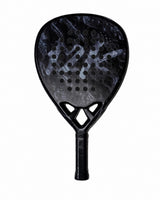
The 12k Padel Midnight Black is built to exactly that spec, with a 12K carbon face that holds its shape when you drive down through the ball. Read the rebound, get behind the ball, and the rest follows.