How to Hit a Bandeja in Padel: The Shot That Wins Matches

If you have played padel for more than a few weeks, you have faced the deep lob. Your opponents flick the ball over your head, you watch it drift towards the back glass, and the net position you worked for is gone. The bandeja is the answer. It lets you stay at the net, keep the pressure on and send your opponents back to the baseline again.
This guide covers how to hit a bandeja in padel, from grip and footwork to contact point and recovery. It is written for UK club players who keep hearing the word on court and want a version of the shot they can actually use next week.
What Is a Bandeja and Why Does It Matter
Bandeja is Spanish for tray. Watch a good player hit one and the name makes sense. The racket face stays open and travels high across the body, as if they were carrying a drink above their shoulder.
A bandeja is an overhead hit with controlled slice at roughly three-quarter pace. You use it when an opponent lobs you and a full smash is not on. Instead of retreating to the glass, you hold your ground near the net and redirect the ball deep with placement rather than power.
Players who never learn it give up the net every time they get lobbed. Players who do learn it keep the attacking position, and the attacking position is where most padel points are won. LTA Padel coaching material treats it as the first overhead to learn for exactly that reason.
When to Use a Bandeja
Not every lob is a bandeja. Reading the ball as it leaves your opponent's racket is half the shot.
The simple rule: if the lob is short and you can hit above your shoulder while moving forwards, smash it. If you are moving backwards or the ball will reach you around head height, play a bandeja. If the ball is dropping behind you towards the glass, let it bounce and play a bajada off the back wall instead.
The bandeja lives in that middle zone, and the middle zone is where most lobs land in club padel. Give yourself a few sessions of deliberately choosing it before you worry about winning points with it.
The Grip and Stance
Use a continental grip, the same one you volley with. It lets you slice through the ball rather than drive flat through it. A forehand grip closes the face and sends the ball long almost every time.
Turn your shoulders side-on the moment you see the lob go up. Point your non-dominant hand at the ball. That keeps your head still and your balance steady while your feet shuffle back into position, with most of your weight on the back foot at first.
The sideways stance is the single biggest difference between a clean bandeja and a flaily one. Most players who miss are still facing the net at contact. A fresh, tacky overgrip helps here too, because a continental grip only works if the handle is not sliding in a sweaty hand. The 12k Padel overgrips are made for exactly that.
The Swing Path
Take the racket up and back, not behind your head like a tennis serve. Think of the backswing finishing with the racket pointing at the sky, face slightly open, elbow high.
As you swing, the racket travels high to low and brushes down the back of the ball. Make contact in front of your body at about eye height. A good check is to imagine wearing glasses and hitting the ball in line with the lenses. If you contact above or behind your head, the slice disappears and the ball floats.
Weight moves from back foot to front foot as you hit. Instead of swinging all the way down, let the racket come across your body so your arm finishes wrapped round you like a scarf. That finish is what keeps the ball low and gives you time to recover to the net.
Where to Aim
A good bandeja travels long and low with enough slice to stay down after it bounces. Aim for the ball to land between the service line and the back glass.
Cross court is the default. It gives you the longest diagonal, so you have more margin and more time to get back to the net. Into the corner is even better, because a ball that hits side glass then back glass slows right down and is awkward to attack.
Down the middle also works, especially against a pair who have not decided who takes the central ball. Down the line is the riskiest option. The court is shorter that way and a loose bandeja sits up for a counter.
Common Mistakes and How to Fix Them
Hitting flat instead of with slice is mistake number one. If your bandejas keep flying long, check that the face is open at contact and that you are brushing the ball rather than punching it.
Contacting behind your body is number two. It usually means your feet stopped moving too early. Take one more shuffle step back than feels necessary so the ball is in front of you.
Hitting too hard is number three. The bandeja is about keeping the net, not ending the point. A slower, deeper ball with good slice is worth far more than a flashy winner that clips the tape. Pace also costs you recovery time, and a bandeja you cannot recover from is a lob you have just lost anyway.
Practising the Bandeja
The best drill is simple. A partner on the opposite baseline feeds lob after lob while you stand at the net. Hit twenty cross court, then twenty into the corner, then swap. Recover to the net after every single one, even in practice.
Wall drills alone do not replicate the shot, so this is one to book a court for. Ten minutes of lobs and overheads at the start of each session, twice a week, will change your game inside a month. Filming yourself on a phone shows you contact point and finish far better than any description.
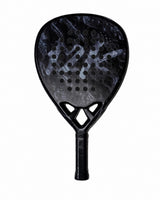
The racket matters too. A teardrop head with a 12K carbon face and medium balance gives you stability on off-centre hits, which is most bandejas at club level, while staying quick enough to turn for the next volley. A very head-heavy frame makes this shot harder, not easier, because the head lags behind your hand on the way through. That is why 12k Padel builds to a medium balance.
Questions Players Ask About the Bandeja
What is the difference between a bandeja and a vibora?
Both are sliced overheads used to keep the net. The bandeja is the controlled version, hit with a flatter swing and an open face, mostly for depth and safety. The vibora adds a bent elbow, more wrist and a lateral brush across the ball, so it comes off faster with heavy sidespin. Learn the bandeja first. Our vibora guide covers the step up.
Should I smash or bandeja a lob?
Smash when the lob is short enough to hit above your shoulder while moving forwards. Bandeja when you are moving back or the contact point is at head height. Players who smash everything lose far more points than they win, usually because they never learnt the alternative. Our smash guide covers when the aggressive option is on.
Why does my bandeja keep going long?
Almost always one of three things. The face is too closed because you are using a forehand grip, the contact is above or behind your head instead of in front at eye level, or you are hitting flat through the ball rather than slicing down the back of it. Fix the grip first and the other two often follow.
Bringing It All Together
The bandeja is the shot that separates players who stall at beginner level from players who start climbing. It keeps you at the net, puts the other pair under pressure and rewards patience and footwork over raw power.
Spend a few sessions on it, be patient with the misses and expect it to click somewhere around week three. Every player who hits a clean bandeja today used to flail at lobs just like you.
If you want a racket built for this kind of controlled, net-based padel, the 12k Padel Ice White pairs a 12K carbon face with a teardrop shape and medium balance at 365 grams, which is exactly the spec that makes a bandeja feel stable without slowing your hands.