Padel Levels Explained: How UK Ratings Actually Work

Sooner or later someone asks the question. What level are you? It comes up when you book a court, when you join an open match on an app, when a WhatsApp group needs a fourth.
The honest answer for a lot of us is a shrug. So this guide explains what the numbers mean in 2026, how the main rating systems in the UK work, how they compare to each other, and how to find a number you can say out loud without wincing.
Why levels suddenly matter
Five years ago you just turned up and played. Now most UK padel is booked through apps, and open matches are filtered by level. Join a match rated 2.5 to 3.0 as a real 4.0 and nobody has fun. Join as a 1.5 and you spend an hour apologising.
A level is not a judgement. It is a matchmaking tool. Getting it roughly right is the single best thing you can do for your enjoyment of the sport, because even matches are the fun ones. It also decides which UK padel leagues and box ladders you can enter, so it is worth understanding properly.
The Playtomic scale, 0 to 7
Playtomic is the booking app most UK clubs use, so its rating has become the default language for padel levels here. The scale runs from 0 to 7. Almost everyone reading this sits between 1.0 and 4.5.
When you sign up, the app asks a few questions about your racket sport background and gives you a starting number. From then on it works like a chess rating. Play a competitive match through the app and your level moves based on the result and the level of the players you faced.
Beat a pair rated above you and your number climbs. Lose to players rated below you and it drops. A narrow loss to a much stronger pair costs you almost nothing. Friendly matches you never record change nothing at all, which is why some regular players carry ratings that lag well behind their real game.
The reliability percentage
Next to your level sits a reliability figure, and it matters more than most players realise. It shows how confident the algorithm is in your number. Low reliability means big swings after each match while the system works you out. High reliability means small moves of a tenth of a point at a time.
Expect your first five to ten rated matches to be a calibration period. Your level can jump half a point or more either way in that stretch. Once reliability passes roughly 85 percent the app treats your level as validated and it settles down. Fifteen to twenty rated matches against varied opponents usually gets you there.
The LTA rating, 1.0 to 7.0
The LTA has governed padel in Britain since 2020 and runs its own rating for sanctioned competition. It uses a scale from 1.0 to 7.0 in half-point steps, and you need one to enter LTA Padel Tour events. Unlike Playtomic, it does not tick up and down after every club match. It is set from tournament results and rated match play, so it moves when you compete, not when you play socially.
The LTA descriptions are worth knowing because clubs borrow them. A 3.5 is a competent tennis or squash player who is new to padel. A 4.0 is controlled on court with a basic grasp of padel tactics.
A 4.5 covers the court very well with good tactical understanding. A 5.0 is an experienced tournament player.
Separate from the rating is the LTA ranking, which is a points table built from your best six tournament results in the previous 52 weeks. Rating is how good you are. Ranking is how much you have won. Our guide to padel tournaments in the UK covers how to enter your first one.
MATCHi, Padel Mates and the rest
MATCHi, the other big booking platform in UK clubs, uses a 1 to 10 scale that you mostly declare yourself, with lighter adjustment behind the scenes. Padel Mates moved to an algorithm on the same 0 to 7 scale as Playtomic, but it is a different algorithm fed by different matches, so the numbers still drift apart.
None of these convert neatly into each other. A Playtomic 3.0 is not automatically an LTA 3.0, and a MATCHi 4 is a rough match for a Playtomic 3.0 to 3.5 at best. If you play at more than one club, check which system each one uses before quoting a number.
What the numbers look like on court
Numbers are abstract, so here is roughly what they mean in practice on the Playtomic scale.
Around 1.0 to 2.0 you are learning to keep the ball in play. Serves go in most of the time, the glass is still frightening, and rallies are short. Every player starts here.
From 2.5 to 3.5 things click. You use the back wall rather than flinching at it, you lob on purpose, and you win points with placement instead of waiting for errors. Most club players in the UK live in this band, and matches here are some of the most fun in the sport.
From 4.0 upwards you are a strong club player. You defend off both walls, you play bandejas to keep the net, and you think in patterns rather than single shots. Above 5.0 sits the world of serious tournament padel, and those players do not need this article.
How to find your level honestly
Self-rating goes wrong in both directions. Some players rank themselves low out of modesty and ruin the match for weaker opponents. More common is the flattering guess, which gets exposed in the first three points.
The fix is data. Record your competitive matches on whichever app your club uses and let the algorithm do its work. Fifteen or so rated matches against varied opponents gives you a number that reflects reality.
Results you track yourself help too. At 12k Padel we always tell players to keep a simple record of matches, scores and who they played. Patterns show up fast. If you keep losing 6-2 to the same pair, that says something a self-assessment never will.
Moving up a level
Levels move slowly once your reliability is high, and that is by design. One good evening does not make you a 4.0.
What moves the number is playing slightly above your comfort zone. Seek out matches where you are the weakest player on court. You will lose more, your rating may dip for a fortnight, and your actual game will improve faster than it would grinding wins against weaker pairs.
The rating catches up. It always does.
Coaching speeds this up, and so does an honest review of where your points actually go. Count your unforced errors in one match. The number is usually humbling, and cutting it is the fastest route from 2.5 to 3.5 there is. If you have been stuck on the same number for months, our guide on how to get better at padel faster is written for exactly that.
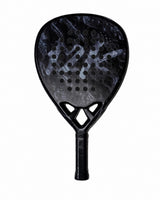
Kit plays a part too. A beginner racket that flexes and twists on every off-centre hit hides the progress you are making. A 12K carbon teardrop at 365 grams with a medium core, like the Ice White from 12k Padel, gives you the control to turn improving technique into points that actually move your rating.
Questions UK players keep asking
What level is a beginner in padel?
On Playtomic, anything up to about 2.0. A complete newcomer with no racket sport background usually starts around 0.5 to 1.0. Someone who played tennis or squash seriously often starts at 2.0 to 2.5 and settles there within a few matches.
How long does it take to reach level 3 or level 4?
Most people who play once or twice a week sit somewhere between 2.8 and 3.3 after their first year. Reaching 3.5 to 4.5 normally takes two to three years of regular club play. Breaking past 4.0 almost always involves lessons, tournament matches or a strong tennis background, because the gap between 3.5 and 4.0 is mostly tactical and does not close on its own.
Why did my Playtomic level go down after a win?
Usually because your reliability was still low and the algorithm was recalculating from earlier results at the same time. It can also happen when your partner is rated well above you and the pair was expected to win comfortably. Once your reliability is high these wobbles stop.
Keep score of the thing that matters
Whatever the apps say, your real level lives in your results. The Game Keeper score tracker from 12k Padel clips onto the court fence so you never lose track mid-match, and it makes recording accurate results at the end painless. Know your score, log your matches, and the level takes care of itself.