Left Side or Right Side in Padel: How to Choose Where You Play
Every padel pair faces the same question before the first serve: who takes the left and who takes the right? Plenty of players pick a side at random on day one and never think about it again. That is a wasted decision, because the two sides ask for different things, and finding the one that fits you can change how many matches you win.
Here is what each side actually involves, and how to work out where you belong.
The two sides do different jobs
In Spain the right side is called the drive and the left is the reves. The names give the game away. For two right-handed players, the person on the right plays most wide balls on the forehand, while the person on the left has their forehand facing the middle of the court.
That one detail shapes everything else. Most attackable balls land in or near the middle. The player whose forehand covers that zone gets first claim on them, which is why the left-side player ends up hitting most of the smashes.
It also changes how the walls play. On the right, the ball coming off the side glass tends to arrive on your forehand. On the left, the same rebound comes to your backhand, so the left-side player needs a backhand off the wall that does not fall apart under pressure. Our guide on using the walls in padel covers the basics if that part of your game still feels shaky.
What the right side asks of you
The right-side player builds the point. Your job is consistency. Keep the ball in play, place returns deep, and use the lob to drag opponents away from the net. You hit fewer winners than your partner. You also make fewer errors, and in padel that trade wins matches more often than raw power does.
Patience is the real skill here. Right-side players spend long stretches of a rally doing quiet, unglamorous work, then create the one opening their partner turns into a point. If your ego needs the highlight shot, the right side will test you.
The return of serve matters more on the right too. You receive the first point of every game and every point after an even score, like 15-15 and 30-30. A steady, low return that keeps the server off the net is worth more than any single winner.
Signs the right side suits you
You rarely give away cheap points. You like long rallies and do not get restless waiting for an opening. Your lob is dependable under pressure. You read the game well and enjoy setting traps more than springing them.
What the left side asks of you
The left-side player finishes the point. With your forehand in the middle, most overheads are yours, so you need a smash or a vibora you trust and the confidence to take balls that sit between you and your partner. Hesitate on the left and the whole pair suffers.
The left also carries more risk. You will make more errors than your partner because you are playing the harder, more aggressive shots. That is fine. A left-side player who never misses is probably not attacking enough.
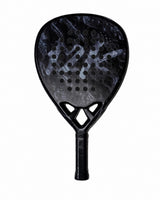
Your racket choice matters a little more here as well. Left-side players hit more overheads in a match than anyone else on court, so a teardrop frame with a medium balance and a stiff carbon face pays off. The 12k Padel Shark Blue is built on exactly that spec, with enough head to put the smash away and a frame that still turns quickly in a fast exchange at the net.
Signs the left side suits you
You have a reliable overhead and you enjoy hitting it. You move quickly and like dictating the pace. You handle pressure points well, because the deciding ball usually comes to the left side. Coaches at every level tend to put the stronger finisher there.
Who takes the middle ball
This argument happens on every court in the country, so let us settle it. The standard rule is that the player with the forehand in the middle takes the middle ball. For two right-handers, that means the left-side player calls it.
A loud, early shout of mine or yours beats any rule, though. We break down the exceptions in our guide to who takes the middle ball, and the talking habit behind it in our piece on communicating with your padel partner.
What if one of you is left-handed
A left-hander flips the logic. Put them on the right side and both forehands meet in the middle, which gives you frightening smash coverage but leaves both wide channels on the backhand. Put them on the left and both forehands cover the wide balls while the middle becomes backhand territory.
Most pairs with a leftie choose the first option and accept the trade. Coaching advice is close to unanimous on this. If you get the chance to play with a left-hander, take it. Opponents who have grooved their lobs against right-handed pairs suddenly have to rethink every target.
How to actually choose
If you are new to padel, do not specialise yet. Rotate sides for your first few months. You learn the full court, you understand what your partner deals with, and you find out where you naturally win more points instead of guessing.
Once you play regularly with the same partner, have the honest conversation. Who finishes better? Who defends better? At 12k Padel we hear from plenty of players who spent a year on the wrong side simply because nobody wanted to bring it up. Five minutes of honesty beats twelve months of quiet frustration.
And if you both want the same side, book a friendly and play a set each way. The scoreboard is a fair referee.
Keep a note of it too. After four or five matches each way, look at which side gave you fewer unforced errors and more points won at the net. Gut feel is unreliable after a good or bad evening. A small tally over a few weeks is not.
Questions players ask about padel sides
Which side should a beginner play in padel?
Both, for the first few months. If you have to pick one for a single match, the right side is the gentler start. You play more forehands into open space, you are asked to keep the ball in rather than win the point, and the decisions are simpler.
Is the left side harder in padel?
It is more demanding rather than harder. The left-side player covers more overheads, takes most middle balls and plays more backhands off the side glass. It suits players with a strong smash and quick feet. A solid defender can find it exhausting.
Does the better player go on the left?
Often, but not always. The left tends to go to the stronger finisher, which is not the same thing as the stronger player. A partner who rarely misses and reads the game well can be more valuable on the right than they would be on the left.
Do professional players switch sides?
Yes. Many pros have played both sides over their careers depending on who they partner. Most settle on one side for years once a partnership beds in, but very few are locked to it, which is a good reason not to commit too early yourself.
Settle your side, then settle your racket
Whichever side you land on, the racket in your hand should match the job. Right-side players lean on control, left-side players on power, and a balanced racket covers both while you work out where you belong. The 12k Padel Ice White is built as exactly that kind of all-rounder, forgiving enough for the builder, quick enough for the finisher. Pick your side, grab your racket, and go win the argument about the middle ball properly.