Padel Singles: Can You Play 1v1 and How Does It Work?
Someone drops out an hour before your booking. You are left with one other player and a court you have already paid for, which raises the obvious question. Can two people play padel properly, or is it just hitting?
You can play it properly. Padel singles is a recognised format with its own court size and its own rules. What most people in the UK end up playing in 2026 is an improvised version on a normal court, and that works fine as long as you agree the rules before you start.
The Official Singles Court
The International Padel Federation defines a singles court as 20 metres long and 6 metres wide. Same length as the doubles court you already know, four metres narrower.
Everything else stays put. Glass at both ends, mesh down the sides, net at the same height, service line 6.95 metres from the net, service boxes marked the same way. If you want the full measurements for the standard court, our padel court dimensions guide has them.
That narrow width is the entire idea. Six metres is roughly what one player can cover without flat out sprinting, so rallies stay long and the shots that win points in doubles still win them here.
Where to Find One in the UK
Almost nowhere. Dedicated singles courts appear at competition venues and at the odd club with land to spare. Rocket Padel in Ilford is one of the few UK venues with a singles court you can actually book.
The economics explain why. A singles court costs close to what a doubles court costs and sells half the peak-time slots, so clubs build the wide one. If you want the official format, you will be travelling for it.
Playing Singles on a Normal Court
This is what actually happens. Two players, one standard 10 metre court, and far more ground each than the format was ever meant to hand you.
It works, but the full width turns the match into a running contest. Angles that a partner would have covered are now open floor, and whoever hits widest wins most of the points without doing anything clever.
One agreed limit fixes it. The usual version is cross-court only, where the ball has to land in the half diagonally opposite you, which brings the width you defend back down towards the official six metres. Some groups play half-court instead, where each player owns one lengthways half and the centre line is the boundary. Cross-court is the better game because it keeps the diagonal, which is where padel angles come from.
Agree These Before the First Serve
The serve does not change. Underarm, contact at or below waist height, one bounce first, into the diagonal box.
Decide whether the side mesh counts. In doubles it is part of the court. On a wide court with two players, allowing every ball off the side fence stretches rallies out until somebody quietly stops chasing.
Scoring stays exactly as it is. Points, games, sets, tie-break, golden point if that is what your group plays. There is no reason to invent anything, and if either of you is hazy on the details our padel scoring guide settles it in two minutes.
How the Game Itself Changes
Singles is not doubles with a gap where your partner used to be. The tactics move.
You Cannot Live at the Net
In doubles you take the net and hold it, because two of you across the front is a wall. On your own it is an invitation. Anything lobbed over your shoulder is a winner, and you are turning and running from a standing start every time.
The workable position is a step or two further back than feels right, usually around the service line. You give up some finishing power and you stop losing points to lobs you had no chance of reaching.
The Lob Gets Even Better
Everyone underrates the lob in doubles. In singles it is close to a cheat code, because the person it goes over has nobody to cover for them.
Two or three good ones early sets the tone. Your opponent stops committing forward, and the short ball you play next becomes unreachable. If your lob is the weak link, read our guide to playing the lob in padel before your first singles session, because you will hit more of them in one hour than in a month of doubles.
Angles Beat Power
Hitting hard down the middle is pointless when there is one player standing in it. The ball comes straight back and you have burned energy for nothing.
Move them side to side instead. Wide, then wide again the other way, then short. Padel singles is won by whoever makes the other player cover the most distance, and that has very little to do with how fast you swing.
Your Grip Will Go First
Nobody warns you about this one. An hour of singles produces the kind of sweat a doubles match never does, and a grip that felt fine at the start is slick by the second set. A slipping handle makes you squeeze harder, and squeezing harder is what tires the forearm and sends your volleys long.
Carry a spare and change it when it goes shiny. A pack of 12k Padel overgrips lives in most of our players' bags for exactly this reason, and it costs less than the court.
Why It Is Worth Playing
Fitness is the honest headline. An hour of singles asks more of your legs than two hours of club doubles, and the recovery time between points disappears entirely.
There is a technical case too. Every ball on your side is yours, so you touch the ball four or five times more often than usual. Players who spend a few sessions on singles come back to doubles with better footwork and cleaner contact, mostly because they had nowhere to hide.
It also solves the odd-number problem. Plenty of players at 12k Padel have had a court booked, one person cancel, and a session that would otherwise have been wasted.
When Singles Is the Wrong Call
Skip it if you are carrying anything in a knee, ankle or achilles. The stop-start load is heavier than doubles and the court is bigger than your legs want it to be.
Skip it too if the gap in standard between you is wide. Doubles hides a mismatch reasonably well. Singles exposes it inside three games and neither of you enjoys the rest of the hour.
Warm up for longer than you would before a normal match. The first sprint into a corner is where people pull things. If you plan to make singles a regular thing, the leg and hip work in our padel fitness training guide is what stops that happening.
Questions People Ask About Padel Singles
Is padel singles harder than doubles?
Physically, yes, and it is not close. A 2023 study comparing match load found players in singles padel recorded higher heart rates, more distance covered and higher perceived exertion than the same players in doubles. Tactically it is simpler, because there is no partner to coordinate with, but every decision and every metre is yours alone.
Is padel singles good exercise?
It is one of the best hours of cardio you can get with a racket in your hand. Expect long rallies, constant direction changes and almost no standing around. If your goal is fitness rather than match practice, singles on a full court, with no cross-court limit, is the most demanding version.
Are there professional padel singles tournaments?
Not on the main tours. Premier Padel, the FIP circuit and the LTA competitive structure in the UK are all doubles only, and there is no official world singles ranking. Singles shows up in exhibition events, club nights and the occasional one-off tournament, so treat it as a training format rather than a competitive path.
Getting a Game
Book as normal and turn up with one other player. Clubs charge for the court, not the heads, so nobody minds.
Some venues run one-on-one sessions in quieter off-peak hours, and coaches will happily play a singles set at the end of a lesson if you ask. Otherwise it is a text to the one person in your group who always says yes.
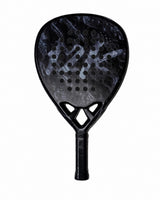
Because you are covering the whole court alone, the racket matters more here than it does in doubles. You will be hitting on the stretch constantly, and a frame that stays forgiving when you are out of position keeps far more balls in play than one built purely for the smash. The 12k Padel Midnight Black is built for exactly that, with a 365 gram teardrop frame and a large sweet spot that holds up on the shots you reach at full stretch. Sort the racket, agree your rules on the first point, and stop cancelling sessions just because somebody dropped out.