Padel Court Dimensions Explained: Size, Walls and Markings

Every padel court on the planet is the same size. That sounds like trivia until you realise what it means: the court you play on in Manchester is identical to the one used in a Premier Padel final. Same length, same walls, same net. Only the players change.
Knowing the actual numbers helps more than you might think. Once you know how deep the service box is or how high the back glass runs, you stop guessing distances and start playing them. Here is the full breakdown.
The basic footprint: 20 metres by 10
A regulation padel court measures 20 metres long and 10 metres wide, with a tolerance of just 0.5 per cent either way. That gives you a playing area of 200 square metres, split into two 10 by 10 halves by the net.
For comparison, a tennis court is 23.77 metres long and almost 11 metres wide for doubles, plus all the run-off space behind the baselines. Padel squeezes four players into a much smaller box, and that compression is where the sport gets its character. Nobody is ever more than a few steps from the action.
The net: lower than you think
The net stands 88 centimetres high at the centre and 92 centimetres at the posts. It spans the full 10 metre width with no gaps at the sides.
That is roughly 3 centimetres lower than a tennis net at centre. Not a huge difference, but combined with the slower ball it makes low, skimming shots like the chiquita far more playable than they would be on a tennis court.
Lines and service boxes
Padel keeps its markings simple. There are only three painted lines on each half: a service line running parallel to the net, a central line splitting the service area in two, and that is it. No baselines, no tramlines.
The service line sits 6.95 metres from the net. The central line divides the space between net and service line into two boxes, each 6.95 metres deep and 5 metres wide. All lines are 5 centimetres wide and must contrast clearly with the surface.
Here is the detail that trips up new players: the lines only matter on the serve. Once the ball is in play, the whole enclosed court is live, walls included. A ball landing behind the service line mid-rally is not out. There is no out, as long as it bounces on the floor before hitting fence or glass on your side.
The back walls: 3 metres of glass, 1 metre of mesh
Each end of the court is closed by a back wall 4 metres high. The bottom 3 metres are solid, usually toughened glass at commercial clubs, though concrete and brick are legal too. The top metre is metal mesh.
That 3 metre glass line matters in real play. A ball that hits the glass on the full is out. A ball that bounces first and then comes off the glass is very much in, and learning to let it come back to you is the single biggest adjustment for anyone arriving from tennis. The extra metre of mesh above catches the wild stuff.
The side walls: a staircase of glass and fence
The side walls step down as they move away from the corners. From each back corner, the first 2 metres of side wall are solid to a height of 3 metres. The next 2 metres drop to 2 metres high. The remaining 12 metres along the middle of the court are metal fence.
The fence itself runs 3 metres high through the central section and rises to 4 metres at the ends to match the back walls. This stepped layout is why side wall bounces feel less predictable than back wall ones. Depending on where the ball lands, it might be coming off glass, off fence, or off the join between the two.
Height above the court
Indoor courts need a minimum of 6 metres of clear space above the entire playing surface, and the international federation recommends 8 metres for new builds. Some older UK conversions sit right at the minimum, which is why your highest lobs occasionally clip a beam. Most venues play a let when that happens, but check the house rules before you rely on the moon ball.
Singles courts exist too
Padel also has an official singles format played on a narrower court: 20 metres long but only 6 metres wide. They are rare in the UK, though a few clubs have added them. The game feels different, with less angle to work with and far more running. If you find one, try it. It is a brutal workout and a sharp test of your straight-line game.
What the numbers mean for your game
Dimensions sound dry until you attach tactics to them. Knowing the court is 10 metres deep on your side tells you how much room a lob needs to clear the opponents and still drop in. Knowing the service box ends 6.95 metres from the net tells you where to stand when returning. Knowing the glass starts 2 metres in from each corner tells you which balls will rebound cleanly and which will hit the fence and die.
At 12k Padel we spend a lot of time talking about positioning with players, and almost every positioning rule comes back to these fixed distances. The court never changes. That is the good news. Learn its geometry once and it pays you back in every match you ever play.
The walls reward players who trust them. Next time you train, spend ten minutes just feeding balls into the back glass and watching how far they rebound. You will build a mental map of the court faster than any diagram can give you.
Same court everywhere, so bring your own edge
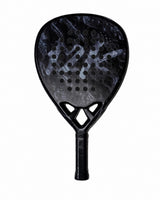
Since every court is identical, the variables that decide matches are the ones you carry through the door: your fitness, your tactics, and your racket. If your current frame is holding you back, the Midnight Black from 12k Padel is a 12K carbon racket built for exactly the kind of controlled, wall-savvy game this article describes. The court will always be 20 by 10. What you do inside it is up to you.