Padel Out of Court Rules: Can You Play the Ball Outside?
The first time I saw someone run out of a padel court, through the gate, and flick the ball back over the net, I assumed they had made it up. It looked like cheating. It is not. It is one of the oldest rules in the sport and the reason padel looks nothing like tennis when a point goes long.
Most people find out about it by accident. A lob drops deep, the ball squeezes through the side opening, and one player sprints after it while everyone else stands still wondering whether the point is over.
What the out of court rule actually says
If the ball bounces on your side of the court and then leaves through one of the side openings, the point is still live. You can run out through the gate, chase the ball down, and hit it back over the net. Land it in the opponents' court and play carries on as normal.
Two conditions matter. The ball has to bounce inside the court first. And it has to leave through an opening, not over the top of a wall or fence.
That second part causes more arguments than anything else in club padel. Ball over the glass, point is done. Ball through the gate, someone should be running.
The bounce count does not reset
This catches people out constantly. The one bounce rule follows the ball outside. If it bounced once inside and bounces again in the corridor before you reach it, you have already lost the point.
So chasing an escaped ball usually means taking it out of the air, or getting there before that second bounce lands. On a slow, floaty lob you might have time. On anything with pace you almost never do.
Why you probably cannot do it at your club
Here is the part nobody mentions in the highlight reels. Out of court play only applies on courts built for it.
The regulations ask for two access points per side and a clear safety corridor around the court, with padding on the surrounding surfaces. From January 2026 the required corridor width went up from two metres to three, with four recommended at professional venues. The reasoning was simple. Players are running faster than they were a decade ago and two metres was not enough room to stop safely.
Plenty of UK club courts are wedged into car parks, warehouses and converted tennis bays. There is a wall, a fence or a neighbouring court a metre past the gate. On those courts the ball leaving the playing area ends the point, and that is the right call.
Ask before your first match at a new venue. Most clubs have a house rule and will tell you in about five seconds. At 12k Padel we get this question more than almost any other from players who have watched a bit of pro padel and want to know why their local court plays differently.
When it actually happens
Two situations produce nearly all out of court balls.
The first is a deep defensive lob that clears the net players and drops close to the back glass. It kicks off the glass at a steep angle, runs along the back of the court and slips out through the side gate.
The second is a hard cross-court shot that catches the corner where the glass meets the side wall. The rebound comes out flat and fast, aimed straight at the opening.
Learn to read both. The corner rebound is the one worth watching for, because the ball tends to hold a low, predictable line once it exits.
How to chase one without hurting yourself
Go early or do not go at all. The decision has to be made while the ball is still travelling on your side, not after it has already left.
Call it. Shout something short so your partner covers the middle and does not follow you out. Two players outside the court is a lost point and a collision waiting to happen.
Get low through the gate. The frame is narrower than it looks and people clip a shoulder on it far more often than they trip over their own feet.
Keep the return simple. From outside the court you have a bad angle and no balance. A high, deep ball that buys you time to get back in is worth more than an attempted winner you will shank into the fence.
Getting back in
Once you have hit it, come back through the nearest opening and take your position. No rule forces you to use the same gate you went out of, but there is a rule about stalling. The twenty second clock keeps running while you are out there.
Is it worth practising?
If your club courts allow it, yes, though not in the way you might expect. The value is not in pulling off one highlight recovery a season. It is in recognising, half a second earlier, when a ball is going to escape through the gate and when it is going over the glass.
Players who read that correctly stop wasting energy on lost causes and stop giving up on retrievable ones. Across a season that is worth far more points than any single spectacular save.
And if your courts do not allow it, nothing is really lost. The rest of the game is unchanged, and you get a slightly simpler version of the sport with fewer arguments about whether the ball went over or through.
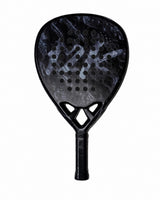
One last thing. Chasing balls outside the court is hard on equipment. Frames scrape gates, walls and tarmac far more than they ever do inside. If your racket has been taking hits and you are ready for something that holds its shape, the Shark Blue from 12k Padel is built for players who go after everything. Worth a look before your next session.