Best Padel Racket for Tennis Players: What to Buy in 2026
Tennis players make up a big share of the people walking onto UK padel courts for the first time. Most of them turn up with a borrowed club racket, enjoy the session, and then search for the best padel racket for tennis players before the week is out.
The good news is that your tennis background makes you a better buyer than a complete beginner. You already know what weight, balance and feel mean in your hand. The bad news is that the instincts you bring from tennis will steer you towards the wrong padel racket, and the shop will happily sell it to you.
Why tennis players buy the wrong racket
In tennis, more weight and a stiffer frame reward a good player. You swing long, you hit through the ball, and the racket turns your pace into winners. So a tennis player picks up a diamond-shaped padel racket, feels the weight sitting in the head, and thinks that is the serious option.
It is the wrong option for the first year. Padel points are won with short swings, placement and patience at the net. A head-heavy diamond frame with a small sweet spot punishes the long swing you are trying to unlearn and turns every slightly late volley into a frame shot. Players who buy one after a strong first session usually swap it within a few months.
Weight: lighter than you think, but not light
Most adult padel rackets sit between 350 and 375 grams. A tennis player's instinct is to go to the top of that range because a 300 gram tennis frame feels like a toy by comparison. Resist it. The padel swing is short and the racket is unstrung, so the extra grams go straight into your elbow rather than into the ball.
The window that works for almost every tennis convert is 360 to 370 grams. That is enough mass to block a hard ball at the net without the frame twisting, and light enough to flick a reflex volley or turn a bandeja over without dragging the head through the shot. Anything 375 grams or more can wait until you have played a full season.
Shape: teardrop, not diamond
Head shape sets the size and position of the sweet spot. A round racket keeps it big and central, which is the safe pick for someone who has never held a racket. A diamond pushes it up towards the tip for smash power and shrinks it in the process.
Tennis players sit between those two groups. You already make clean contact and you do not need the training wheels of a round frame, but you are not yet hitting padel overheads with the right technique. A teardrop gives you a sweet spot slightly above centre, which is where tennis players naturally strike the ball on a volley, and still forgives the mishits that come while your swing shortens.
Balance: medium, and check it yourself
Balance is where tennis players get caught most often. A head-heavy racket feels powerful in the shop because your tennis arm knows how to use that mass. On court it makes the racket slow to turn at the net, and net play is where padel matches are decided.
Look for a medium balance. Hold the racket loosely at the end of the handle and see whether the head drops hard. If it does, it is head-heavy regardless of what the label says.
A medium balance keeps enough weight up top to put a smash away and still lets you react when a ball comes at you fast.
Core: the spec with no tennis equivalent
There is nothing in a tennis racket that behaves like a padel core. The foam inside the frame decides how long the ball sits on the face and how much shock reaches your hand. A hard core gives a crisp, direct response that feels familiar to a tennis player, and that familiarity is exactly the problem. It rewards the hard flat hit you need to stop playing.
A medium EVA core is the right call. The ball sinks into the face for a fraction longer, which gives you feedback on placement and takes the sting out of a blocked volley. It also protects an elbow that has already done years of tennis service. Pair it with a real carbon face rather than fibreglass and the racket keeps that feel for two or three seasons instead of going soft in one.
Grip: thinner than tennis, and that is fine
Padel grips are much thinner than tennis grips and the handle is far shorter. Tennis players often find this unsettling and ask for a thicker base grip. Do not. A thinner grip lets the wrist move freely, which is what the soft volleys and angled wall shots need.
Buy the racket with the slim factory grip and add one overgrip if your fingers nearly touch your palm when you close your hand. Add two if you have large hands. That is the whole adjustment.
The spec in one line
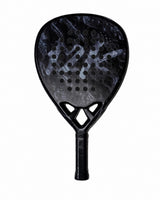
For a tennis player buying a first padel racket: 360 to 370 grams, teardrop head, medium balance, medium EVA core, carbon face, slim grip. That racket will not hold you back in year one and you will not have outgrown it in year three.
12k Padel builds one racket to that exact spec. Every frame is 365 grams with a teardrop head, medium balance, a medium EVA core and a full 12K carbon face. It is the spec we would hand to any tennis player at a UK club night, and it is the one most of them end up choosing once they have tried a few.
Questions tennis players ask before buying
Can I use my tennis racket for padel?
No. Padel rules require a solid, unstrung racket with a perforated face, and the court is far too small for a 27 inch frame anyway. Our padel vs tennis racket guide explains the structural differences in detail.
Should a tennis player buy a beginner padel racket?
Not a true beginner racket. Those are built around a soft core and a round head to flatter a slow swing, and a tennis player will feel them as flat and vague within a few weeks. Skip that tier and buy a medium core teardrop with a carbon face. It costs about the same from a direct-to-player brand and lasts far longer.
How long does it take a tennis player to adjust?
Most take two to four weeks of regular play for the shorter swing and the walls to feel natural, and the right racket makes that period shorter. Our guide to making the switch from tennis covers the habits to drop first.
Where to start
If you want the spec above from a UK brand that sells direct and keeps the price under what a carbon tennis frame costs, the 12k Padel Midnight Black is the one to look at. Teardrop, 365 grams, medium balance and a 12K carbon face, with a slim grip you can build up to fit your hand.