Padel vs Tennis Racket: What's the Actual Difference?
If you've played tennis and you're moving to padel, the racket in your hand is going to feel wrong for about two weeks. Then it'll feel right. But it helps to understand what changed and why — because the two sports optimise for completely different things.
The Core Difference: Strings vs. Solid Face
Tennis rackets are strung. Padel rackets are solid. That's the fundamental structural difference, and everything else follows from it.
A tennis racket generates power primarily through string tension — the strings deflect on impact and snap back, adding energy to the ball. The frame is mostly a tension-holder.
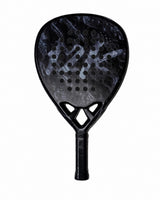
A padel racket has a solid foam or rubber core covered in a rigid carbon or fibreglass face. Power comes from the combination of core compression and face stiffness. The harder the face material and the denser the core, the more energy transfers directly to the ball.
Size and Weight
Tennis rackets run 27–29 inches long. Padel rackets are 45.5cm (about 18 inches) with a maximum total length including the handle of 45.5cm. Much shorter.
Weight is similar — padel rackets typically land between 340g and 390g, comparable to a mid-weight tennis racket. But the feel is completely different because the weight distribution in padel varies by shape (round, teardrop, diamond) in ways tennis rackets don't.
Grip Length
Tennis grips are long — 4–5 inches of handle for two-handed backhands and leverage on serves. Padel grips are short, around 10cm. Padel is almost entirely one-handed. The short grip and light head allow very fast wrist action for the angled shots off walls that define the game.
The Wall Factor
Padel is played with glass walls. You use them. A significant part of the game involves hitting balls off the back and side walls — sometimes playing the ball back after it bounces off the glass, sometimes deliberately angling shots into walls to change direction.
This puts different demands on a padel racket than a tennis racket faces. The carbon face needs to be durable under repeated hard contact with walls, not just ball impacts. A well-made carbon racket generally holds its feel longer than a fibreglass one, though any racket wears with use.
Can You Use a Tennis Racket for Padel?
No. Padel rules specify that the racket must be solid — no strings. A tennis racket is illegal in padel and wouldn't work well anyway: it's too long for the enclosed court, the stringing behaviour on wall shots would be unpredictable, and the grip length is wrong for padel technique.
Switching from Tennis to Padel
The biggest adjustment is the shorter swing. Padel points are won with compact strokes, angles, and placement — not the full-swing groundstrokes of tennis. Players who've played tennis often over-swing initially.
The racket choice for ex-tennis players: teardrop shape, mid-weight (360–370g), full carbon construction. The 12K Padel range fits this: 12K carbon face, teardrop shape, 365 g, £79.95. Free UK delivery over £90.
See also: How to choose your first padel racket | Best carbon padel racket under £100