How Much Should You Spend on a Padel Racket? UK Price Guide
Walk into any sports shop in the UK and padel rackets run from £40 to £400 on the same wall. Nothing on the frame tells you why one costs ten times the other. So the question we get asked more than almost any other is a simple one: how much should you spend on a padel racket?
The honest answer for most club players is somewhere between £70 and £120. Below that you are buying something you will replace within a year. Above it you are mostly paying for a name. Here is what the money actually buys at each level, so you can decide for yourself.
Under £50: fine for a taster, not for a season
This is the fibreglass end of the market. The face flexes a lot, the core is soft foam, and the sweet spot is big and forgiving. For your first three or four sessions that is no bad thing. You will get the ball back and you will not hurt your arm.
The problem is what happens next. Cheap foam compresses, so the racket that felt lively in week one feels dead by month four. The fibreglass face scuffs and softens from wall and floor contact, and the edge often cracks without a protector. If you play once a week, you will be shopping again before the year is out, which makes the cheap racket the expensive one.
£70 to £120: where the racket stops holding you back
This is the range we point nearly every UK club player towards, and it is where 12k Padel builds its own rackets. At this price you should expect all of the following, and you should walk away from anything that is missing one of them.
A carbon face
Carbon holds its stiffness. A frame bought here gives the same response in its second season as it did in its first week, which is the thing fibreglass cannot do. That alone is worth the step up from the budget frame.
A medium EVA core
Firm enough that a clean strike comes off the face with pace, soft enough that a blocked volley does not ring up your arm. This is the core most players stay on for years once they find it.
A teardrop shape around 365 grams
The all-round spec. Big enough hitting zone for the back of the court, enough head to put an overhead away. Weight in the 360 to 370 gram window keeps it stable without slowing you down by the third set.
A textured surface
A sandy face grips the ball for slice on the bandeja and bite on the volley. Smooth faces at this price are a sign the money went into the paint rather than the build.
Get those four right and you have a racket that will carry you from your first few months to a solid intermediate level without needing to be replaced. Our guide to the best padel racket under £100 turns this into a six-point checklist you can take to any shop.
£120 to £200: paying for stiffness you may not want
Above £120 you start to see higher carbon counts, harder cores and diamond shapes. These are real differences, not marketing. A stiff 18K face with a hard core gives an advanced player with a fast swing a sharper, more powerful response.
The catch is that the same racket makes a club player worse. A hard core punishes the mishit, a diamond head shrinks the sweet spot and moves it up, and a head-heavy balance is slow in a quick net exchange. You are buying a tool built for a swing you do not have yet. Plenty of people in this band would play better with the £80 racket.
£200 and up: the price of the name
At the top of the wall, the build is often very similar to the £150 frame two slots along. What changes is the sponsorship bill, the pro endorsement and the retail margin. The carbon is not better carbon. The foam is not better foam.
If you compete at a high level and have tested a particular frame and know it suits you, spend the money with a clear head. If you are a club player buying on the assumption that the dearest racket must be the best one, you are paying £120 extra for a logo.
Are expensive padel rackets worth it?
Worth it for a small number of players, and a bad buy for most. A premium racket rewards a fast, clean, repeatable swing and punishes everything else. Until you hit the middle of the face four times out of five and know which side of the court you play, the extra stiffness is a cost rather than a benefit.
The better test is not price but spec. Two rackets with a carbon face, a medium core and a teardrop shape at 365 grams will play far more alike than their price tags suggest, whether one costs £80 and the other £180.
How much should a beginner spend on a padel racket?
If you are certain you will play fewer than ten times, borrow one from the club. If you think you will stick with it, which most people do, go straight to the £70 to £100 band and skip the budget racket altogether. You save the cost of buying twice, and you never have to adjust to a new frame six months in.
When is it time to spend more?
When your current racket is the thing holding you back, and you can name the reason: lobs landing short, volleys dying on the face, a soft beginner frame that cannot keep up with the game plan you now have. Our guide on when to upgrade your padel racket runs through those signs one by one.
Even then, the right upgrade for most players is the £70 to £120 spec above, not the £250 one.
Why the right spec costs less than it used to
A carbon face, a medium EVA core and a teardrop frame do not cost more to make than their cheaper alternatives. The high street price was always the brand, the distributor and the shop each taking a cut. A UK brand selling direct can put the £150 spec on the court for half that, and 12k Padel does exactly that.
The short version
Spend £70 to £120. Insist on a carbon face, a medium EVA core, a teardrop shape around 365 grams and a textured surface. Avoid the sub-£50 fibreglass frame if you plan to play for more than a few weeks, and avoid the £200 pro frame unless your swing has earned it.
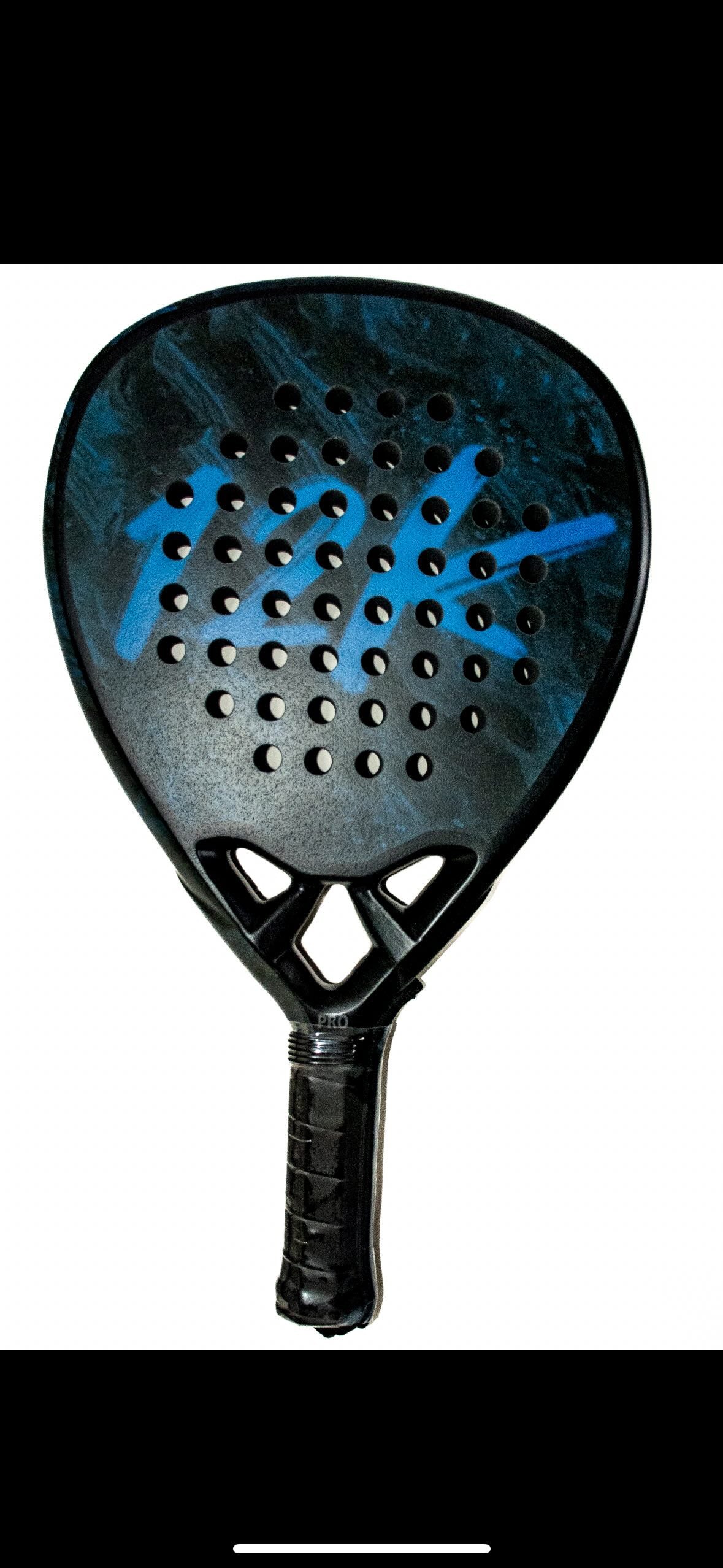
If you want that spec at the bottom of the range rather than the top, the 12k Padel Midnight Black is a full 12K carbon teardrop at 365 grams for £79.95. It is the racket we would hand to any UK club player who wants to buy once and get on with playing.