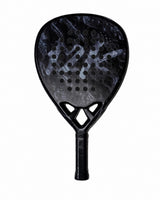
Control vs Power Padel Racket: Which Should You Buy?

Every padel racket on sale in the UK gets filed under one of two labels. Control or power. Most people buying a first or second racket end up asking the same thing: which one is right for me?
The honest answer is that the label is a shortcut for four or five specs working together. Once you know what those specs are, the control vs power padel racket question gets much easier to answer. And the answer for most club players is not the one the marketing pushes.
What control and power mean on a spec sheet
A control racket is built to make clean contact easy and to keep the ball where you aimed it. That means a round head, a sweet spot in the centre of the face, balance sitting low towards the handle, and usually a softer core.
A power racket is built to turn a fast swing into a faster ball. Diamond head, sweet spot pushed up towards the tip, balance high in the head, and a firmer core that gives the ball a sharp exit when you catch it cleanly.
Neither is better. They are tuned for different players, and the trade-off never changes. The more a racket gives you in power, the more it takes away in forgiveness.
Shape does most of the work
Head shape is the first thing to look at because it sets the size and position of the sweet spot. A round face keeps the sweet spot big and central, so a slightly late or off-centre hit still clears the net with pace. A diamond face shrinks it and moves it up, which helps a smash and hurts a tired volley late in a set.
Teardrop sits between the two. The sweet spot moves a little higher than on a round frame, which adds depth on lobs and bite on overheads, but the hitting zone stays wide enough that mishits are not punished. Our guide to padel racket shapes goes through each one in detail.
Balance decides how the racket feels in the hand
Two rackets can weigh the same and feel very different depending on where that weight sits. A head-heavy balance puts mass behind the ball on a smash and makes the racket feel powerful on a slow swing in the shop. It also makes the frame slower to turn at the net and loads your elbow on every stop and start.
A low balance feels quick and light. Reflex volleys are easier, and your arm is fresher after ninety minutes. The cost is that you have to generate the pace yourself, and a flat-footed smash from a low balance racket will not have much on it.
Medium balance is where most players end up. There is enough mass at the top to finish a point and the frame still turns quickly in a fast exchange. More in our padel racket balance guide.
Core and face set the feel on contact
Softer cores sink the ball into the face and spring it back, so you get free pace on a gentle swing and less vibration up the arm. Harder cores give a crisp, direct response but pass more shock to the hand and only produce power when you swing hard.
The face material works the same way. Fibreglass flexes and flatters a slow swing. Carbon stays stiff, holds its shape for years and rewards a clean strike. A 12K carbon face over a medium EVA core gives you the precision of carbon without the harshness, and it is the build 12k Padel uses on every racket.
Who should buy a control racket
If you have played fewer than twenty or thirty times, buy for control. Points at this level are lost on errors far more than they are won on winners, and a round or teardrop frame with a medium or soft core cuts those errors straight away.
Control is also the right call if you have had any elbow, wrist or shoulder trouble. The lower balance and softer core keep the shock out of the arm, and that matters more than a few extra miles an hour on your smash.
Defensive players who like to lob, block and wait for the error should stay on the control side whatever their level. The racket should match how you win points, not how you wish you did.
Who should buy a power racket
A diamond-shaped power racket makes sense when your technique is grooved enough to find the sweet spot without thinking about it. That usually means a couple of years of regular play and a smash that is already a weapon.
If you are not there yet, a power racket will make you worse before it makes you better. The small sweet spot turns a slightly late volley into a frame shot, and the high balance makes the racket feel heavy by the third set. Plenty of UK club players buy a diamond frame after one good session and go back to teardrop within a season.
Why the middle is the right answer for most players
Here is what the control vs power framing misses. The two categories are the ends of a line, and almost everyone playing weekly padel in the UK belongs somewhere in the middle of it. A teardrop head, medium balance and a medium core give you a sweet spot that forgives, enough mass to put a bandeja or smash away, and a frame that stays comfortable through a long session.
Beginners grow into that spec, intermediates get everything they need from it, and plenty of strong club players never move off it because the extra power is not worth the extra errors.
12k Padel builds one racket to exactly that spec: 365 grams, teardrop head, medium balance, medium EVA core and a full 12K carbon face. It sits right on the line between control and power.
Questions people ask before choosing
Should a beginner buy a control or a power racket?
Control, every time. A big sweet spot and a comfortable core help you build a repeatable swing, and that swing is what produces power later. A power racket at this stage just adds mishits.
Is a teardrop racket control or power?
Both, which is the point. Teardrop frames are usually sold as all-round or hybrid rackets because the sweet spot is slightly raised for power but still wide enough for control.
Can you get more power from a control racket?
Yes, and mostly through timing rather than the racket. Hitting the middle of the face with a full swing produces more ball speed than catching a diamond frame off centre.
The short version
Buy for control if you are new, injury-prone or a defensive player. Buy for power only when your technique is consistent and you already win most of your points at the net. Buy the middle if you are anything in between, which is most of us.
If you want that middle-ground spec from a UK brand that sells direct, take a look at the 12k Padel Ice White. Same teardrop frame, medium balance and 12K carbon face, in a clean white finish.