How to Find Padel Partners in the UK: Where to Actually Look

Getting a court is the easy part. Finding three other people who are free at the same time, play at roughly your level, and will actually turn up is the bit nobody warns you about.
Most people who drift away from padel do not lose interest in the game. They get tired of organising it. Here is how to stop that happening.
Start at the Club, Not on Your Phone
Almost every UK club runs some form of organised play. Mix-ins, Americanos, club leagues, beginner sessions, group coaching blocks. All of it exists for people arriving on their own.
Walk in, ask at reception what runs midweek, and book onto something. In ninety minutes you will play alongside six or eight different people, and you only need two of them to be a decent fit.
While you are standing there, ask to be added to the club WhatsApp group. That one question beats a month of scrolling through apps. A huge amount of UK padel is still organised in WhatsApp threads, and clubs almost never advertise them on the website.
What a Mix-In Actually Involves
Rounds last ten to fifteen minutes. Partners change every round, opponents change every round, and you carry individual points rather than pair points. Nobody is keeping a running record of how good you are.
An Americano runs on the same idea with a bit more structure. You never partner the same person twice in a session. It is the standard social format in the UK and most clubs group them loosely by beginner, intermediate and advanced.
Expect to pay somewhere around ten to fifteen pounds a head. That is often cheaper than splitting a peak court four ways, and you get far more variety of opponent for the money.
Use the Booking Apps for Open Matches
Playtomic runs most UK clubs and its open match feature is the closest thing padel has to proper matchmaking. You create a session at a set time and level, then other players fill the empty slots.
MATCHi shows up at leisure centres and multi-sport venues. ClubSpark covers a lot of LTA-affiliated clubs that bolted padel courts onto an existing tennis site. Padel Mates leans harder into the social side, with partner finding as the whole point rather than an extra feature.
Be honest about your level when you set it. Inflating your rating gets you into games where you spend an hour chasing lobs and everyone finishes slightly annoyed. Understating it is no better. Somebody has to carry the rally.
Post Early, Not on the Day
Open matches that go up three or four days ahead fill. Ones posted at four o'clock for a seven o'clock start usually do not. Peak slots on weekday evenings and weekends disappear roughly a week in advance, so plan on that timescale.
Group Coaching Is Partner Finding in Disguise
A six or eight week block puts you with the same three or four players every week, all at a similar standard, all committed enough to have paid up front. That is a ready made group handed to you.
Half the people I know at 12k Padel who play regularly met their fixed four in a beginner coaching block. The coaching improves your game, which matters, but the contacts are the part that keeps you playing two years later.
Build a Fixed Four
Players who get on court every week almost all have the same setup. A group of four to six names, one recurring slot, one WhatsApp thread. Nothing clever about it.
Six is the useful number. Four means one cancellation kills the session. Six means you have cover without the group getting so big that nobody feels responsible for showing up.
Lock the Slot In
Book the same time every week and treat it like any other fixed commitment. Tuesday at eight, every Tuesday. Once it stops being a negotiation, the admin disappears and you just play.
Book blocks where the club allows it. Some venues will let you hold a recurring slot, which takes the weekly scramble out of it entirely.
The Wider Net
Local Facebook groups still work, particularly in cities where the padel scene grew faster than the number of courts. Search your town plus padel and you will usually find one with a few hundred members posting about spare slots.
Club leagues are worth a look once you have played a few months. They pair you with a partner for a season, which forces the kind of consistency that social play does not.
Work is another one people skip. Padel spreads through offices faster than almost any other sport, mostly because it is four people and nobody needs to be good. One message in a team channel often turns up two players you did not know had a racket.
Turning Up Alone Is Completely Normal
The thing that stops most people is the assumption that everyone else already has a group and they would be intruding. Clubs run mix-ins precisely because that assumption is wrong and they know it.
Padel is doubles, which means every club has a permanent shortage of fourth players. You are not a nuisance. You are the thing three people in a WhatsApp group are currently hunting for.
Go once, say yes to the next session somebody invites you to, and the problem solves itself inside a month.
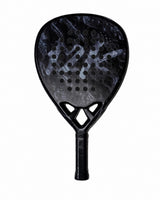
One practical note. Once you are in mix-ins and social sessions you will be playing far more often than you did as a casual, and a borrowed club racket starts to feel like the limiting factor quickly. The 12k Padel Midnight Black is built for that stage, when you are on court weekly and want a frame that keeps up. Sort the racket, then go and find your four.