Mixed Doubles Padel: How to Build a Partnership That Actually Wins

Mixed doubles padel has a way of exposing every assumption you carry onto court. You show up expecting the same rhythms as a regular match, and within three points you realise that two players with different instincts, strengths, and shot preferences do not automatically become a functional pair. Chemistry in mixed doubles is not something that just happens. You build it.
The format rewards smart thinking more than power. If you and your partner are willing to work on a handful of habits together, you will win matches that looked unlikely from the warm-up.
Stop Dividing the Court by Gender
The most common error in mixed padel is also the one nobody talks about directly. Most pairs, without even discussing it, split the court based on gender. The assumption often runs like this: the male player covers more ground, takes the overhead shots, chases the difficult balls. The female player plays a supporting role and hangs back.
It does not work. What it actually creates is uneven court coverage, one player trying to carry the point while the other waits to react, and a dynamic where the opponents can immediately see who to target. Pairs that split responsibility by ability rather than assumption win more matches.
Before the match, have a five-minute conversation with your partner. Who is more comfortable at the net? Who reads the ball quickest? Who has the stronger backhand lob? Build the structure around what is actually true, not what seems expected.
Move Together or Lose Together
This applies to all doubles padel, but mixed pairs get it wrong more often because the instinct to protect your partner can work against you. When one of you goes forward, the other goes forward. When one drops back to retrieve, the other adjusts. You move as a unit.
Watch pairs who struggle and you will see the same pattern every time. One player is at the net, the other is mid-court, there is a gap between them, and the opponents aim directly into that gap. The solution is simple on paper and harder in practice: stay roughly parallel to your partner at all times. A useful reference point is never to let more than a racket length of horizontal distance open between you.
The Middle Is Where Points Are Won and Lost
In mixed doubles, opponents who know what they are doing do not go for the sidelines. They go for the middle. A ball played between two players creates hesitation, and hesitation loses points.
Agree in advance who takes balls through the centre. A common default is whoever has the forehand on that side, but what matters is that you have a shared answer before the first point is played. During the rally there is no time to negotiate.
Communication Without the Noise
Good communication on a padel court is three or four words per rally, maximum. Mine. Yours. Switch. Back. That is about all you need mid-point. Everything else gets processed between points.
Between points, keep check-ins short. Did that pattern work? Are they targeting the same player each time? Do we need to be more patient getting to the net? The pairs that talk too much during play tend to distract themselves. The pairs that go quiet tend to drift out of sync. Find the middle ground and stay there.
One thing that genuinely differs in mixed padel is that partners often need to adjust how they communicate based on temperament. Some players want a word of encouragement after an error. Others reset better in silence. Pay attention to what your partner actually needs and adjust accordingly.
Shot Selection That Holds Up Under Pressure
Mixed doubles is not the format to be looking for winners off every exchange. High, deep balls are what control the pace and keep opponents away from the net. The pair that hits patient, well-placed lobs and forces their opponents back will outperform the pair that goes for low shots and flat drives in almost every recreational match.
The parallel lob deserves particular attention. Hit it down the line, aimed deep toward the corner, and it forces your opponents off their net position. Your pair can then advance together and take control. Practice this until it feels automatic, because it will rescue you from defensive positions repeatedly.
When you spot a weakness in how your opponents are set up, go back to that target consistently. Serve to the same spot two or three times. Build pressure through repetition rather than variety.
Net Control Is the Whole Game
The pair at the net in padel has options. The pair at the back is reacting. Getting to the net together, and staying there together, is not a tactic you use sometimes. It is the entire approach.
After any shot that puts your opponents under pressure, both of you move forward. After a strong serve, move forward. After a lob that lands deep and forces a scramble, take the net together. When you get there, quick deep volleys are more effective than trying to angle winners. Keep them pinned, keep the pressure on, and let errors come.
The Right Equipment Helps
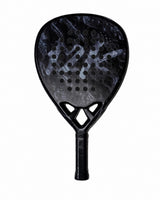
For players who take their mixed doubles seriously, what you carry onto court matters. At 12k Padel, the Shark Blue has a 12K carbon face that gives you a firm, precise feel for net play and enough feel to place deep balls from the back of the court. Bold by design, it suits players who want to arrive on court ready.
The Short Version
Mixed doubles padel is one of the most enjoyable formats in the game when the partnership actually functions. The pairs that sort out the structure early, who move together and communicate cleanly, win more and enjoy it more. 12k Padel is built for players who take that side of the game seriously.
Move together. Cover the middle. Communicate without cluttering the rally. Stay patient. Get to the net as a unit and hold it. Sort the structure first. The individual game will follow.